How To Set Up A Home Security System On A Budget
You want protection that actually works — not gizmos that chirp at every squirrel. I spent years watching systems fail at the moment they were needed, so I’m sticking to what’s practical: easy setup, reliable recording, sensible motion filtering and real night vision. In this roundup you’ll find solid choices for renters (battery/solar, minimal drilling), homeowners (wired DVRs and mixed systems) and anyone who’s tired of false alarms. Pro tip: prioritize cameras with adjustable motion zones and human/vehicle detection — that’s the single best way to stop alert fatigue without missing real events.
⚡ Quick Answer: Best Home Security
Best for Alexa Smart Homes: Ring Alarm 14-Piece Kit (newest model), Wireless smart home or business security system, expandable, easy setup, Mobile App Control, 24/7 Professional Monitoring, Alexa Compatible
$329 — Check price on Amazon →
Table of Contents
- Main Points
- Our Top Picks
- Ring Alarm 14-Piece Kit (newest model), Wireless smart home or business security system, expandable, easy setup, Mobile App Control, 24/7 Professional Monitoring, Alexa Compatible
- aosu Security Cameras Outdoor Wireless, 4 Cam-Kit, No Subscription, Solar-Powered, Home Security Cameras System with 360° Pan & Tilt, Auto Tracking, 2K Color Night Vision, Easy Setup, 2.4 & 5GHz WiFi
- ANNKE 3K Lite Wired Security Camera System Outdoor with AI Human/Vehicle Detection, 8CH H.265+ DVR and 8 x 1920TVL 2MP IP67 Home CCTV Cameras with Smart Dual Light, Color Night Vision, 1TB Hard Drive
- Ring Alarm 8-Piece Kit (newest model), Home or business security system with optional 24/7 professional monitoring
- Home Alarm System with Camera, 23 Pieces Wireless WiFi/GSM SMS Home Security System with Motion Detector, 120dB Alarm Siren, Remote Control, Doorbell Button and SOS Button for Villa,Warehouse
- Alarm System for Home Security,24Pcs WiFi+GSM/4G Door/WindowAlarmSystem Kit,with Touch Screen & App Alerts&Auto Alarm Dial Compatible with Alexa,for Apartment,Kids Safety NO Monthly Fees
- Ring Battery Doorbell (newest model), Home or business security with Head-to-Toe video, Live View with Two-Way Talk, and Motion Detection & Alerts, Venetian Bronze
- Buying Guide
- Frequently Asked Questions
- Conclusion
Main Points
- Cover the likely attack vectors first: front door (package theft), side doors (blind spots) and driveway. Battery doorbells and two‑way talk are ideal on the porch for instant interaction; pan/tilt solar cams can track delivery handlers across a wider field.
- Wired vs wireless is about trade-offs, not "better or worse." Wired DVR/IP systems (ANNKE with H.265+ and a 1TB drive) give the most reliable 24/7 recording and no ongoing fees — best for homeowners who can run cable. Wireless/solar and battery systems (aosu, Ring Battery Doorbell) are fastest to install and renter‑friendly but watch Wi‑Fi band compatibility (2.4GHz for range, 5GHz for throughput).
- Motion accuracy is where you save time and money. Systems with AI human/vehicle detection or adjustable zone/sensitivity (ANNKE, Ring app motion zones) cut false alarms dramatically compared with cheap motion-only cameras. Night vision quality matters: look for color/dual‑light or true 2K/3K low‑light imaging if you want usable ID shots, not grainy blobs.
- Decide cloud vs local on your terms. No‑subscription cameras and DVRs give you ownership of footage (lower lifetime cost) but require local drives and backups; subscription services add convenience, offsite retention and optional 24/7 professional monitoring (Ring kits offer the latter). Evaluate app reliability and notification tuning — a good app is the difference between a helpful alert and notification spam.
- Price-to-value: cheap cams have a place for secondary coverage; expensive systems aren’t automatically better. Pair a core alarm kit (Ring 8‑ or 14‑piece for sensors and expandability) with a targeted camera strategy (one wired DVR for constant recording, plus solar/battery cams for porches). Pro tip: mount cameras 8–9 ft high angled down ~20–30°, secure with tamper screws, test motion at dusk, and use local backup (SD/HDD) if you want no monthly fees and guaranteed access to footage.
Our Top Picks
More Details on Our Top Picks
-
Ring Alarm 14-Piece Kit (newest model), Wireless smart home or business security system, expandable, easy setup, Mobile App Control, 24/7 Professional Monitoring, Alexa Compatible
The Ring Alarm 14-Piece Kit earns "Best for Alexa Smart Homes" because it actually becomes part of your Echo ecosystem instead of sitting on the sidelines. You can arm and disarm with voice, fold alarm events into Alexa routines, and pull up camera feeds on Echo Show devices for instant porch checks. If you already use Alexa for lighting or routines, this kit lets you automate responses — turn on lights and lock smart deadbolts the moment a sensor trips — without wrestling with multiple apps.
What you get is straightforward: a base station with a loud siren and keypad, a handful of door/window contact sensors, a motion detector, and a range extender in a single, inexpensive bundle. Setup is DIY and fast via the Ring mobile app; if a package disappears from your front porch you can see the timeline and trigger alerts through your Echo devices. The system is expandable — add cameras, video doorbells, and additional sensors — and you can opt into 24/7 professional monitoring if you want emergency dispatch. Pairing Ring cameras gives you decent night vision and two‑way audio for porch theft or a side‑door blind spot, but remember cameras are a separate purchase.
This kit is for you if your house (or rental) already runs Alexa and you want a single connected experience without hiring an installer. Renters like it because the sensors are battery powered and easy to remove; homeowners like it because you can build up a whole-home system over time. Pro tip: during setup place the base station centrally and test every sensor from its installed location — a centrally located base improves wireless reliability across a typical home.
Be honest: Ring's value comes with caveats. Full video history and advanced features require a subscription, and much of the experience relies on cloud services — that’s convenient but not local-first. There are also real privacy debates around Ring’s data policies and third‑party access; if you want local-only storage and maximum privacy, look elsewhere. False alarm fatigue can happen if motion sensitivity isn't tuned, so plan some sit-down time tweaking detection zones after installation.
✅ Pros
- Seamless Alexa integration
- Quick DIY setup for most users
- Good value 14-piece starter kit
❌ Cons
- Relies on cloud for many features
- Privacy concerns with Amazon ownership
Pro tip: mount motion sensors 6–8 feet high and away from HVAC vents to reduce false triggers.
Pro tip: put the base station on a shelf, not in a closet, to maximize wireless range.
- System Type: DIY wireless alarm kit
- Components Included: 14-piece kit — base, keypad, sensors, motion, extender
- Monitoring: Optional 24/7 professional monitoring (subscription)
- Connectivity: Mobile app control, Alexa-compatible, cloud-based
- Best For: Best for Alexa Smart Homes
- Special Feature: Deep Alexa integration and Echo Show camera view
Pro tip: if you pair Ring cameras, enable motion zoning and lower sensitivity near the street to avoid car-triggered alerts.
-
aosu Security Cameras Outdoor Wireless, 4 Cam-Kit, No Subscription, Solar-Powered, Home Security Cameras System with 360° Pan & Tilt, Auto Tracking, 2K Color Night Vision, Easy Setup, 2.4 & 5GHz WiFi
This kit earns "Best for Solar & No-Subscription" because it bundles four wireless cameras with solar panels and lets you run the system without a recurring cloud fee. You get 2K color night vision, 360° pan and tilt with auto-tracking, and local recording options — all for about $299.99 and a solid 4.4-star user score. In plain terms: you can cover multiple approaches to your house and keep the cameras powered long-term without monthly costs.
Hardware and software line up for real-world problems. The 360° pan plus auto-tracking helps you follow a delivery to the porch or a person circling the house, and dual-band Wi‑Fi keeps streams stable if your router is modern. 2K color night vision actually matters — you can identify package labels and clothing in low light better than with monochrome IR. The system's motion-detection needs a little tuning, but once set it's good at catching side-door blind spots without nonstop false alerts. Pro tip: carve out motion zones for sidewalks and streets immediately; it slashes false-alarm fatigue.
Who should buy this? Homeowners with sunny rooflines or renters who can mount panels without heavy wiring. It's ideal if you want multi-camera coverage, minimal ongoing cost, and simple local storage (microSD). Skip it if you need professional monitoring or wide-area wired reliability. For renters: you can often use adhesive or magnetic mounts to avoid drilling, but verify landlord rules first. Pro tip: orient solar panels to get morning and afternoon sun, not just "where it looks good."
Honest caveats: battery performance depends on sun and season — winters cut runtime. App polish is good but not flawless; expect occasional firmware updates. 5GHz connectivity works for quality streams but has shorter range; if a camera is far from the router you'll likely use 2.4GHz. Also, local storage is convenient and subscription-free, but a full microSD can overwrite footage fast if you get heavy motion. Pro tip: use staggered recording (motion-only clips + lower frame rate) to extend local storage lifespan.
✅ Pros
- Solar-powered with included panels
- No cloud subscription required
- 2K color night vision with auto-tracking
❌ Cons
- Battery life varies by sunlight
- Motion sensitivity needs tuning
Pro tip: Mount solar panels where they get direct sun, south-facing if possible.
- Key Ingredient: Solar-powered batteries for low maintenance
- Connectivity: Dual-band 2.4 & 5GHz Wi‑Fi
- Resolution: 2K with color night vision
- Storage: Local microSD recording; no mandatory cloud
- Best For: Best for Solar & No-Subscription
- Special Feature: 360° pan, tilt, and auto-tracking
Pro tip: Stagger motion sensitivity and clip length to conserve storage and reduce false alerts.
-
ANNKE 3K Lite Wired Security Camera System Outdoor with AI Human/Vehicle Detection, 8CH H.265+ DVR and 8 x 1920TVL 2MP IP67 Home CCTV Cameras with Smart Dual Light, Color Night Vision, 1TB Hard Drive
The ANNKE 3K Lite earns "Best for AI-Powered Detection" because its DVR-level human/vehicle classification actually reduces junk alerts in real scenarios. The system pairs eight wired 2MP cameras with H.265+ recording and onboard analytics, so the AI runs locally on the recorder instead of relying exclusively on cloud tagging. That combination—smart dual lights for color night vision plus on-device filtering—gives you fewer late-night false alarms and clearer evidence when you need it.
Key features include H.265+ compression to stretch that 1TB drive, IP67 weatherproof housings, smart dual-light color night vision, and motion detection tuned to human and vehicle signatures. In practice that means you’ll get useful night detail on a package thief at your porch, and the system will ignore a raccoon wandering by most of the time. Wired cameras keep video stable when Wi‑Fi is flaky, and local storage avoids recurring cloud fees while still letting you view clips on your phone. Pro tip: set motion sensitivity and draw exclusion zones in the app to cut road and tree-triggered alerts.
Who should buy this: homeowners who want full perimeter coverage without a monthly subscription and who don’t mind running wires or hiring an installer. It’s a strong value if you need multiple outdoor cameras (driveway, side door, back gate) and prefer local evidence collection. If you’re securing a small business or a larger yard on a budget, it’s worth considering. If you’re renting or can’t alter exterior walls, a wireless kit or video doorbell will be easier to live with. Pro tip: mount cameras 8–10 feet high, angled down, to capture faces and reduce vandalism risk.
Honest drawbacks: 2MP (1920TVL) is solid for identification at moderate distances but won’t match 4K detail. The ANNKE app and firmware are usable but occasionally clunky compared with premium brands—expect occasional updates and a bit of fiddling. The DVR is local, which is great for privacy, but you should secure and bolt the recorder; thieves target DVRs during break-ins. Pro tip: periodically back up critical clips to an external drive or cloud service so evidence survives a stolen DVR.
✅ Pros
- Accurate human/vehicle AI filters false alerts
- Color night vision with smart dual lights
- Eight cameras plus 1TB HDD included
❌ Cons
- 2MP resolution, not ultra-high clarity
- Wired installation requires drilling/cabling
Pro tip: disable motion zones that face the street to reduce nuisance notifications.
- Key Ingredient: On-device AI human/vehicle detection
- Scent Profile: Color night vision with smart dual light
- Best For: Best for AI-Powered Detection
- Size / Volume: 8CH DVR, 8 × 2MP cameras, 1TB HDD
- Special Feature: H.265+ compression and IP67 housings
- Installation Target: Wired homeowner installs, small businesses
Pro tip: keep retention targets realistic—lower frame rate or use schedule recording to extend 1TB storage.
-
Ring Alarm 8-Piece Kit (newest model), Home or business security system with optional 24/7 professional monitoring
The Ring Alarm 8-Piece Kit (newest model) earns "Best for Small Homes" because it covers the critical entry points without overcomplicating things. For apartments, condos, or a modest single-family house, the kit gives you a full control hub, keypad, several contact sensors and a motion detector — everything a small home typically needs. At $249.99 and a 4.7-star rating, it strikes a sensible balance: enough hardware to protect common weak spots, with a low barrier to DIY installation and no immediate contractor calls.
Key features include a central base station and keypad, multiple door/window contact sensors, a PIR motion sensor, and optional 24/7 professional monitoring. The Ring app ties sensors to your Ring cameras and video doorbell, so an alarm can trigger recorded clips and push notifications — useful for catching a porch package thief or spotting activity at a side-door blind spot. The app is one of the better ones in the budget space: straightforward arming modes, push alerts, and stay/away scheduling reduce false-alarm fatigue. Pro tip: mount the motion sensor about 6–8 feet high and angle it down slightly to avoid pet-triggered false alarms.
Who should buy this: renters and small-home owners who want an inexpensive, reliable start to home security without an IT degree. If you value simple DIY setup, app-driven self-monitoring, and the ability to add Ring cameras later, this kit fits. It’s also a good interim solution if you’re planning a future upgrade — you can begin with an 8-piece kit and expand sensors or cameras as needed.
Honest drawbacks: you’ll pay extra for cloud video history and professional cellular backup, and the system plays best inside the Ring ecosystem — third-party integrations are limited compared with pro alarm panels. Expect some tuning: motion sensitivity and notification thresholds often need adjustment to cut down false positives in busier neighborhoods. Pro tip: use adhesive mounts for temporary placement during testing, then move to screws once you’ve optimized sensor locations.
✅ Pros
- Complete starter kit for entry points
- Easy DIY setup, no subscription required
- Solid app and Ring ecosystem integration
❌ Cons
- Cloud video requires paid subscription
- Limited third-party integration options
Pro tip: temporarily mount every sensor with tape first; walk-test zones before finalizing placement.
- Control Hub: Base station with keypad control
- Included Sensors: Contact sensors and PIR motion detector
- Best For: Small homes, apartments, and condos
- Monitoring Options: Self-monitoring or optional 24/7 pro monitoring
- Power / Backup: Mains powered with built-in battery backup
- Special Feature: Native integration with Ring cameras and Alexa
Pro tip: schedule "away" and "home" modes to reduce nuisance alerts during expected activity.
-
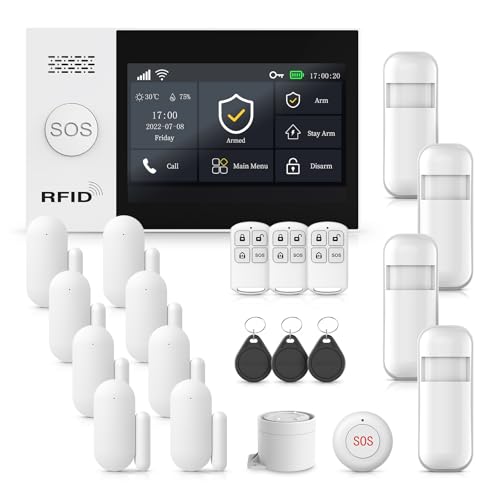
Alarm System for Home Security,24Pcs WiFi+GSM/4G Door/WindowAlarmSystem Kit,with Touch Screen & App Alerts&Auto Alarm Dial Compatible with Alexa,for Apartment,Kids Safety NO Monthly Fees
This kit earns the "Best for No-Monthly Fees" slot because it gives you a complete, self‑monitored alarm system without a subscription. For about $135 you get a 24‑piece kit, a touchscreen control panel, Wi‑Fi plus GSM/4G backup for outages, app push alerts and an auto‑dial feature — all the essentials to protect doors and windows and alert you immediately, without paying a recurring monitoring bill. That price-to-value ratio is exactly what you want if you care about practical protection, not glossy cloud packages.
Key features are straightforward and useful in real scenarios. The 24-piece kit covers most apartments and small homes — use it to secure front‑door and garage entries, and add motion coverage to a side‑door blind spot. GSM/4G acts as a cellular fallback if your internet goes down, and the auto‑dial plus app alerts let you get a call and push notification at the first trigger. App quality and motion accuracy vary with cheaper kits, so expect solid basics rather than professional‑grade analytics. Pro tip: mount motion sensors 6–8 feet high and angle them down to avoid pet false alarms.
Buy this if you’re a renter or a budget‑minded homeowner who wants control and no monthly bills. It’s a good pick for kids‑safety setups, temporary locations, or anyone who wants a DIY alarm system that will still call your phone during an emergency. Setup is typically simple enough for homeowners without an IT degree — and it’s forgiving if you plan to move later.
Be honest about limits: app polish and customer support aren’t industry‑leading, and the cellular fallback usually requires you to provide or activate a SIM card. This is a self‑monitored system — you get alerts and auto‑dialing, but not a 24/7 professional monitoring center unless you add a separate service. If you want advanced integrations, cloud video recording, or top‑tier motion detection, a step up in cost will be necessary.
✅ Pros
- No monthly subscription required
- GSM/4G cellular backup included
- 24-piece kit covers most apartments
❌ Cons
- App experience can feel clunky
- No built‑in professional monitoring
- Key Ingredient: DIY self‑monitoring, no subscription
- Connectivity: Wi‑Fi with GSM/4G cellular backup
- Included Sensors: 24‑piece kit for doors/windows coverage
- Control & Alerts: Touchscreen panel, app push, auto‑dial
- Smart Home: Alexa compatible for basic voice control
- Best For: Renters and budget‑conscious homeowners
-
Ring Battery Doorbell (newest model), Home or business security with Head-to-Toe video, Live View with Two-Way Talk, and Motion Detection & Alerts, Venetian Bronze
The Ring Battery Doorbell earns "Best for Full-Body Video" because it actually sees people from head to toe — not just their faces. Its tall field of view and adjustable mounting angles capture the whole approach to your porch, which matters when you're trying to catch a package thief dropping a box on the step or confirm whether someone turned away before entering a side gate. At $99.99 and a 4.6-star user rating, it hits the sweet spot between usable optics and sensible price.
Key features you’ll use every day: Live View with two-way talk to interrupt porch thieves or instruct a delivery driver, motion detection with adjustable zones so you avoid alerts from the street, and battery power that makes it renter-friendly. The Ring app pushes alerts fast and makes checking events simple. Night performance is reliable in typical porch lighting, and the Venetian Bronze finish hides wear well. Note the trade-off: recordings are a cloud feature (Ring Protect subscription), so you get Live View for free but need the plan for video history.
Buy this if you want straightforward, effective porch coverage without an electrician. Renters and homeowners both get value — renters keep it simple on battery, homeowners can hardwire for continuous power. If your goal is to reduce false alarms, spend five minutes setting motion zones in the app; that step saves hours of notification noise. If you need on-site, local storage or enterprise-level tamper resistance, consider a different system.
Drawbacks are real and honest: recorded clips require a paid Ring Protect plan, and there’s no native local-only storage. Battery life varies with activity — heavy motion zones and frequent Live Views shorten intervals between charges. Pro tip: mount the doorbell 48–52 inches above the ground and angle it slightly down to guarantee full-body capture without cutting off faces.
✅ Pros
- Head-to-toe field of view
- Battery-powered; easy install
- Live View with two-way talk
❌ Cons
- Recorded video needs subscription
- No local-only storage option
Pro tip: If your porch has a blind spot, use a short corner mount or offset bracket to shift the camera line-of-sight — cheap bracket, big security gain.
- Video Quality: High-resolution, full-height field of view
- Power: Battery by default; optional hardwiring
- Best For: Best for Full-Body Video
- Connectivity: Wi‑Fi connection via the Ring app
- Storage: Cloud recording with Ring Protect subscription
- Pro Tip: Mount 48–52 inches for consistent full-body capture
Factors to Consider
Coverage and placement: prioritize sightlines, not sheer camera count
A single well-placed camera beats three that miss the action. Cover entry points first — front door, back/side doors, and the driveway or porch where packages arrive — and avoid pointing cameras straight at the sky or reflective windows. Overlap fields of view so an intruder moving around the house stays in-frame between cameras. Pro tip: mount cameras 7–9 feet high angled slightly down to capture faces and package details while staying out of easy reach.
Video quality and night vision: balance pixels with real-world performance
Resolution matters for identifying faces and license plates, but frame rate and compression affect usable footage more than megapixels alone. Look for cameras with 1080p or 2K and good low-light specs (IR with smart cut-off or color night vision) so a porch theft at 2 AM is still recognizable. Also check sample night footage in reviews — specs won’t tell you about bloom from headlights or washout from street lamps. Pro tip: test night vision before final mounting; small angle changes can fix glare that ruins an entire camera's usefulness.
Motion detection and false alarm control: tune, don’t just accept what the app gives you
False alarms are the number-one reason people stop using systems. Prefer cameras and apps that offer person/vehicle detection, adjustable motion zones, and time-based rules so you don’t get alerts every time a car passes the curb. Take the minute during setup to draw detection zones over trees, sidewalks, and busy streets to cut nuisance alerts. Pro tip: set delivery windows to ignore the driveway motion at times you expect packages, then enable higher sensitivity overnight for theft protection.
Power, connectivity, and reliability: wired where possible, battery for renters or blind spots
Hardwired PoE or AC cameras are the most reliable for home owners who want continuous recording; they avoid battery swaps and Wi‑Fi dropouts. Battery cameras shine for renters, detached garages, or under-eave blind spots, but budget for battery replacements or solar panels. Also confirm your Wi‑Fi coverage — a dropped connection is the most common failure point, so consider an extender or a wired bridge for critical cameras. Pro tip: route Ethernet or power along eaves or inside trim for a clean, theft-resistant install instead of exposed conduit that screams “cut here.”
Storage, privacy, and ongoing costs: decide between local control and cloud convenience
Local storage (microSD, NVR, or NAS) gives you control and no monthly fee, but requires backups and occasional maintenance; cloud storage is easier and often includes intelligent clips but costs monthly and raises privacy questions. For homeowners who want long-term archived footage and no recurring fees, a small NVR or cameras with local recording is the smarter buy. For renters or people who prize simplicity, a cloud plan plus a battery camera makes sense — just factor the subscription into your budget. Pro tip: encrypt or password-protect local storage and enable two-factor auth on cloud accounts to prevent someone else from accessing your footage.
Frequently Asked Questions
How many cameras do I really need to secure my house?
Start with three priorities: a front entry/doorbell camera, a back/side door, and one covering the driveway or street-facing approach. Add more only where you have blind spots or valuables like a garage or backyard equipment. Quality and placement matter more than quantity — cover likely attack routes first, then fill gaps.
Should I get a wired system or battery-powered cameras?
Wired systems are more reliable and better for continuous recording, which is ideal for homeowners; battery cameras are perfect for renters, temporary installs, or places without power. If you choose battery, factor in battery life and plan for solar panels or easy access for swaps. For critical entry points, I recommend wired if possible to avoid missed events when the battery dies.
Are video doorbells worth it for preventing porch package theft?
Yes — a video doorbell provides immediate face and package capture and two-way audio to intervene or scare off thieves, which reduces theft risk. Look for models with good motion zone control and package detection to avoid false alerts from passersby. Pair it with a smart porch light and timed alerts during delivery windows for extra deterrence.
Do I need a professional monitoring service?
No — most homeowners can rely on local recording plus app alerts, but professional monitoring can be worth it if you want emergency dispatch without personal management. If you travel frequently or don’t want to deal with alarm verification, a monitored service reduces response time for break-ins or fire. For budget setups, use smart alarms linked to a neighbor or a paid monthly verification option rather than full-time monitoring.
How do I reduce false alarms from trees, cars, or pets?
Tune motion zones, enable person/vehicle detection, and set sensitivity lower for areas with regular traffic. Mount cameras higher and angle them downward to ignore street-level motion, and use pet-friendly motion settings if available. Regularly review and adjust settings after a week of live use — the right tweaks cut false alerts dramatically.
Can I rely on local storage instead of paying for cloud subscriptions?
Yes — local storage via microSD, an NVR, or your own NAS saves money long-term and keeps control of your footage, but you must handle backups and secure the hardware. Cloud plans are convenient for off-site redundancy, easy review, and person-detection clips, but they add a monthly cost and privacy trade-offs. For a hybrid approach, record locally and pay for cloud only on the most critical cameras.
Are cheap cameras ever a good idea?
Cheap cameras can serve as backups or temporary coverage for a garage or rental, but expect compromises in night vision, app reliability, and firmware updates. Use them where cost matters more than forensic-quality footage, and never rely on them for your primary entry points. If budget is tight, prioritize quality for doors and driveway and put cheaper units on less-critical angles.
Conclusion
You don’t need an expensive pro system to get real protection — you need thoughtful placement, reliable connectivity, and sensible choices about storage and motion rules. Start with a quality video doorbell and one or two wired or long-life battery cameras for blind spots, tune the detection zones, and add cloud or local storage based on how much you want to manage. That combination gives strong, affordable coverage without an IT degree.